Give

Every child learns at their own pace.

A five-minute lesson. Three small tries. At a Lantern, a child who gets them right first time shows the skill and earns fifteen minutes online or of play. The plan runs from a first mouse click to university-level material, across 17 subjects. Try a sample lesson below.

The lessons below are a demonstration of the intended experience. They are not the school system, a released curriculum, a live AI tutor or a formal assessment.

Illustration of a finished sample lesson postcard, as the demo below prints it

Try a lesson. Earn the postmark.

Seven sample lessons across Maths, English and Coding, including a new one on two-step equations. Each is a postcard with three tries. Get all three right first time and the postmark lands.

Demonstration issue · Sample lessons · Not the school system

Stamp book

Choose a subject

Seven short lessons in three subjects. Start anywhere, and come back whenever you like.

Hints are scripted · Progress stays in this browser · No account, no network

Ayò · Oware · Bao · Igisoro · One family of gamesWebsite demo

Spend it on a game of Ayò.

A carved board, two rows of six bowls and 48 smooth grey seeds. Sow them round the board, and take every bowl you turn into a two or a three. Every Lantern country knows this family of games by its own name.

  • AyòNigeria, 2 rows
  • OwareGhana, 2 rows
  • BaoKenya, 4 rows
  • IgisoroRwanda, 4 rows
Ayò and Oware are the same two-row game. Bao and Igisoro are four-row cousins, with rules of their own.
Postage: one token, fifteen minutes.

No sample tokens to spend yet. Earn one in a lesson

Every child gets fifteen free minutes a day, for play or browsing.

The Lantern0You0

The Lantern’s store: 0 seeds
  • The Lantern’s pit 1: 4 seeds
  • The Lantern’s pit 2: 4 seeds
  • The Lantern’s pit 3: 4 seeds
  • The Lantern’s pit 4: 4 seeds
  • The Lantern’s pit 5: 4 seeds
  • The Lantern’s pit 6: 4 seeds
Your store: 0 seeds

The board is set. Spend a token, or today’s free minutes, to light the lamp and play.

How to play

  1. Choose a pit on your row. Its seeds are sown one by one, counter-clockwise, round the board.
  2. If your last seed lands on the Lantern’s row and makes a two or a three, you take them, and every two or three just before it.
  3. You can never take all of the Lantern’s seeds at once. If its row is empty, you must sow seeds into it.
  4. A pit with twelve seeds or more goes all the way round and skips the pit it started from.

The plan includes the Lantern Cup: a mancala league between Lanterns.

Website demo · At a Lantern, a token buys fifteen minutes of play · The plan is for games to run offline, on the Lantern’s own computers
This is a demonstration of how a lesson at a Lantern is meant to feel. It is not the school system, a released curriculum, a live AI tutor or a formal assessment.

Already know it? Break the seal.

A Challenge Test lets a learner prove they already know a whole module and skip it. It is longer and harder than the module’s own test, covers every objective, and asks questions in unfamiliar settings. Try the sample for “Parts of a whole”.

Pass at 90%, with no weak spot
At least 90% overall, and no objective below 75%. A strong score that hides a gap doesn’t pass.
No hints, no clock
Take as long as you need. Every answer is explained at the end.
A fail is useful
You see which objectives fell short, and the module that teaches them. You can try again after three days.

Sample Challenge Test · demonstration only 

Challenge: Parts of a whole

Think you already know fractions of a whole? Prove it and skip the module. There are 14 questions and no hints. Take your time.

  • To pass, get at least 90% overall and at least 75% on every objective.
  • There are no hints in a Challenge Test. You will see every answer explained at the end.
  • About 15 minutes, but there is no clock. You can move back and forth and change answers until you hand in.

It covers every objective of the module:

  1. Say what the top and bottom numbers of a fraction mean.
  2. Make and name a fraction of a whole or a group split into equal parts.
  3. Know that fractions need equal parts, and spot simple fractions that name the same amount.

Learn it. Test it. Go again until it’s yours.

You just walked the loop every child will follow at a Lantern. The real one is longer, and it keeps going until the skill sticks.

  1. Make a profile

    A face and an optional PIN. No email, no username, nothing to forget.

  2. Learn the topic

    A five-minute lesson and a worked example. Every objective has at least two explanations.

  3. Practise

    Three practice questions, with a tutor to ask when you’re stuck.

  4. Take the test

    A quiz at the end of each module. It is written fresh each time, so no two are the same.

  5. Get scored

    Mastery is tracked objective by objective. It counts at 85%.

  6. Hear what to work on

    Then go back through it until you have it. Spaced review brings it back later, so it stays.

Repeat until mastered: back to the lesson, a different explanation, another go.

A tutor that never gives the answer.

A small AI tutor runs on the Lantern itself, so it works with no signal at all. When the Lantern is connected, frontier AI models help with deeper questions, especially at the advanced levels. Either way, the tutor guides. It never just gives the answer.

  • Offline by default: a small model on the Lantern, so lessons, grading and help all work with the dish down.
  • Online, for depth: frontier AI models explain, review code and give essay feedback, mostly at the higher levels. Questions asked offline can wait for the next connection.
  • Children’s names, faces and IDs are never sent to an AI provider. A question leaves with its lesson, and nothing about the child.
  • Scoped to the lesson, with the same rule online and off: the next step, never the answer. Conversations are deleted after 30 days.

This is the plan for the tutor. The demo on this page uses scripted hints, not a live AI.

  1. LearnerIs it 12?
  2. TutorLet’s check. How many oranges are in one basket?
  3. LearnerFour.
  4. TutorAnd how many baskets are there? Count four, that many times.
Illustration of how the planned tutor should reply. The demo above uses scripted hints instead.

Learn, earn, play. Then make your own.

Passing a lesson earns time, and harder lessons earn more. A token buys fifteen minutes online, or fifteen minutes in the Lantern’s game library: games that work offline, chosen to stretch the mind.

DailyFree15 minTokenEarned15 min
Two stamps, a free daily fifteen minutes and an earned token of fifteen minutes, both overprinted “online or play”. Every token, and every child’s free fifteen minutes a day, can be spent either way.
One token, two ways to spend it
Fifteen minutes of filtered browsing, or fifteen minutes of play. The child chooses.
Fifteen free minutes, every day
Every child gets them, whatever they have earned, to spend online or at play.
Earned only by passing
Tokens come from showing a skill, never from time spent or buttons pressed.
Never cash or goods
Tokens buy time and nothing else. They can’t be sold, swapped or spent in a shop.

A session ends at 45 minutes, a child can bank up to three hours, and in school hours learning comes first at the stations.

Every repeat earns less than the last.

Harder modules earn more, and going beyond your level earns a bonus. Straight away, a repeat earns about a third, and by the fourth it earns nothing. Come back a week later and a repeat still earns three-quarters.

The repeats that pay are the ones that help you remember.

Time between repeats
Module difficulty
Above your level

Repeat record · one objectiveThe rule: r equals 0.75 minus 0.45 times e to the power of minus delta t over 1.5 days.First pass: Foundation, 15 min

  1. 15 minFirst passday 0
  2. 4 minRepeat 1day 0
  3. 1 minRepeat 2day 0
  4. 0 minRepeat 3day 0
  5. 0 minRepeat 4day 0
  6. 0 minRepeat 5day 0
  7. 0 minRepeat 6day 0
  8. 0 minRepeat 7day 0
  9. 0 minRepeat 8day 0
  10. 0 minRepeat 9day 0
  11. 0 minRepeat 10day 0

Earned in all 20 minThe most this objective can ever earn is 60 min, four times its first pass.

Illustration of the planned rule, worked for one objective passed eleven times at the same gap. Minutes are whole and rounded down; the rule carries the exact value from pass to pass.

A first pass earns 15, 20, 25 or 30 minutes as modules get harder, plus a fifth more for each level above your own, up to three levels. Prerequisites still gate every module, so the bonus can’t be reached by skipping the foundations. And cramming costs later: each repeat is a share of the one before, so a rushed repeat lowers every review after it.

Book your play.

A child books a slot ahead and sees how many tokens they still need by then. Planning is a skill too.

Player
An avatar, Lantern 1
Day
Thursday
Time
16:00 to 16:45
Game
Ayò, against another Lantern

Paying for 45 minutes

  1. Free today
  2. Banked
  3. Still to earn

1token still to earn by Thursday

Illustration of a planned booking slip, drawn for this page. It is not a screenshot of real software.

Play with Lanterns everywhere.

Children will play children at other Lanterns, on a network only Lantern children can join.

A closed network
Every player is an enrolled Lantern child. No one from outside can join.
An avatar and a Lantern number
That is all another player sees. Never a name, a face or a village.
Preset phrases, never free chat
No voice and no private messages. Players pick set phrases in every Lantern language, so even the chat is a small language lesson.
The facilitator is in the room
For all play. Every game carries an official age rating, and the village approves its own games list, with the facilitator bringing each game to a panel of parents and council members.

Preset phrases, shown here in English

  • Good game
  • Your turn
  • Well played
  • One more?

One game every Lantern country already knows, each by its own name: the mancala family. Ayò in Nigeria, Oware in Ghana, Bao in Kenya, Igisoro in Rwanda.

The Lantern Cup is planned as a mancala league between Lanterns. Prizes are recognition, never goods: a winner goes on the Lantern board as their avatar.

Try the mancala board in the demo
  1. LearnPass a lesson
  2. EarnBank the time
  3. PlaySpend it on games
  4. MakeBuild the next one

Games made by Lantern children.

The Coding track has a game-development strand. It starts with games built from blocks and ends with children building games of their own. A finished game can be submitted, reviewed, and then published to every Lantern, credited to its maker by avatar and Lantern number.

On the curriculum map

  1. CO-GAM-BLGMaking games with blocksLevels 4–8
  2. CO-GAM-GDBGame design basicsLevels 7–11
  3. CO-GAM-PUBPublishingLevels 14–16

Hackathons are planned too, outside opening hours, with the demos on the big screen on the forecourt for parents and the village. A winning game is published at every Lantern.

See Game development on the curriculum map

All of this is planned: the game library, play between Lanterns, booking and children’s own games. Nothing runs yet; the only game you can play today is in the demo.

Separately, the village shares the Lantern’s satellite link as free, filtered public Wi-Fi, with a default of 60 minutes per device per day.

Seventeen subjects. One ladder, all the way up.

The curriculum is planned across 17 subjects, from foundations to university level and beyond. Wave 1 comes first: Digital skills, Maths, English and Coding, for children aged 10 to 15. That is the near-term promise. The rest is planned, wave by wave.

  • Digital skillsThe gateway: a mouse, a keyboard, files, the web, and staying safe online.
  • MathsNumbers that make sense, from fractions to equations and beyond.
  • EnglishReading closely, finding evidence and saying what a story means.
  • CodingMaking something of your own, one line at a time.

Planned for later waves: Sciences, History, every language’s foundations, Literature, Business & economics, Agriculture, Geography, Sports & PE, Engineering, Civics, Arts & culture, Life skills, Health & medicine and Social sciences.

One scale of 18 levels runs through all of it, shown in each country’s own terms. Levels 13 to 18 preview university courses. Levels describe the material, not the child: what unlocks a module is mastering what comes before it, never age.

The Coding path

Coding is one subject among seventeen, and one of the first four. Its ladder climbs past school: algorithms, software engineering, cloud and distributed systems.

  1. BlocksSnap instructions together. See a program run.
  2. PythonType real code. Change a value, run it again.
  3. A tool for a local businessBuild something a shop or stall in the village can use.
  4. The capstoneFrom 15, present a business plan to the village’s adults.

Follow the coding ladder to Level 17

The platform teaches. A person stays.

Every Lantern has a resident facilitator, a local adult who lives in the home upstairs. Not a classroom teacher: someone who opens the doors, keeps the room safe and helps a child who is stuck.

Open six days a week
At least eight hours a day, with an adult track from 17:00 to 19:00.
Checked and trained
Police-checked, with a 90-day probation and a trained community backup for cover.
Lives upstairs
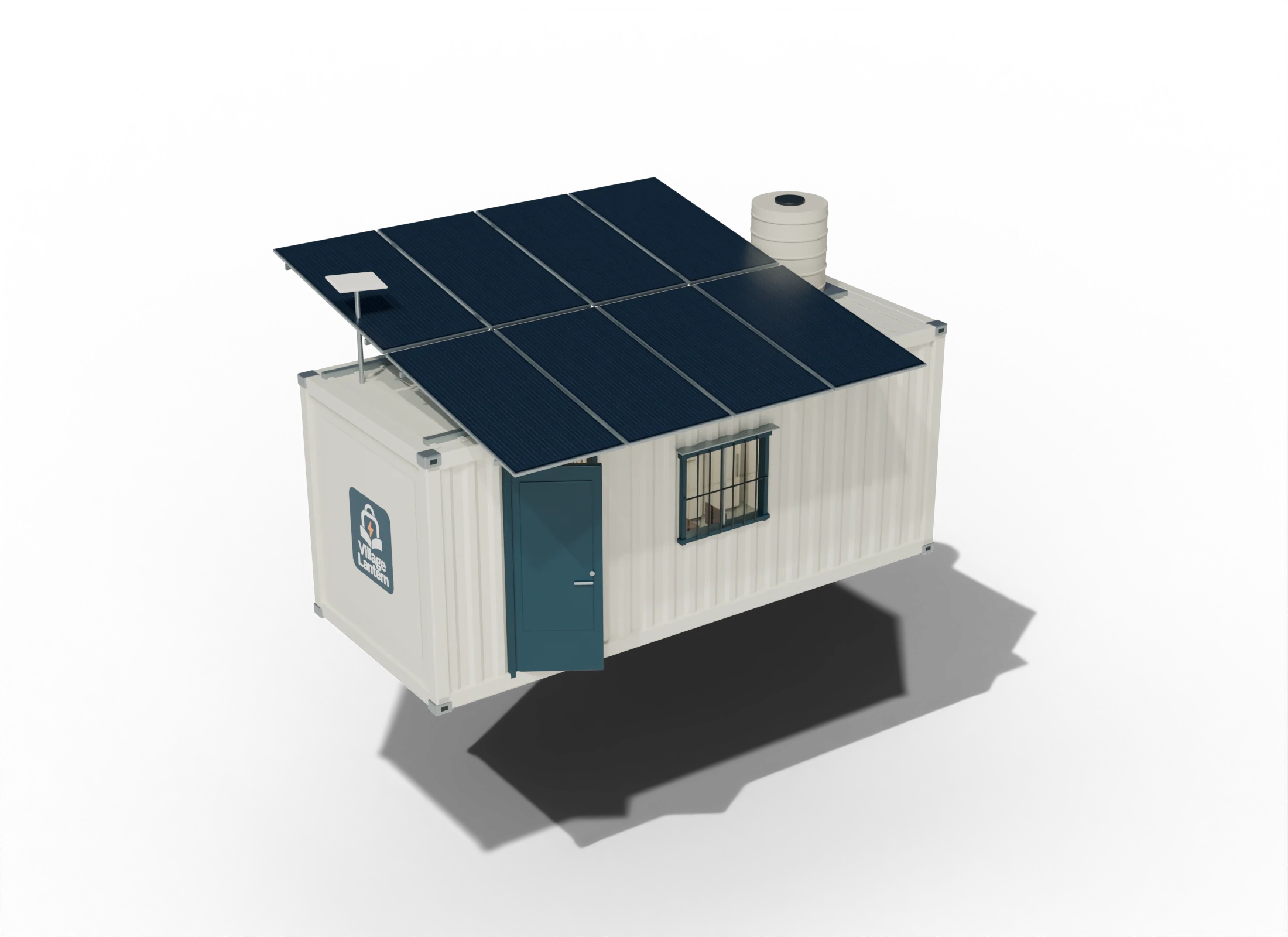
A 20-foot home above the classroom, reached by its own external stair. No child enters it.
Upstairs20 FTDesign visualization of the 20-foot facilitator’s home: a container with solar panels, a door and a barred window.The facilitator’s home
Design visualization of the facilitator’s home

Find the brilliant ones. Then go and get them.

Every objective a child masters is recorded. Over time, those records show us who is flying. The goal is to find them, go and get them, and put scholarships at other institutions in front of them.

“I don’t want to localise someone else’s AI for Africa. I want Africans building African solutions, and that has to start with finding the talent.”

Omi, founder

Our ambition: the best teachers in the world, pro bono.

Our ambition is for the world’s best teachers to build courses for free, so a child in a village learns from the best minds, at their own pace. We are building towards it; it is an ambition, not yet an arrangement.

Teach a course with us

Help light the next classroom.

Every Lantern brings 24 learning stations, a tutor that works offline and a facilitator upstairs to a village. Four are planned and waiting for light.